New Mississippi River Bridge Could Cost Up to $2 Billion; Financing Options Debated
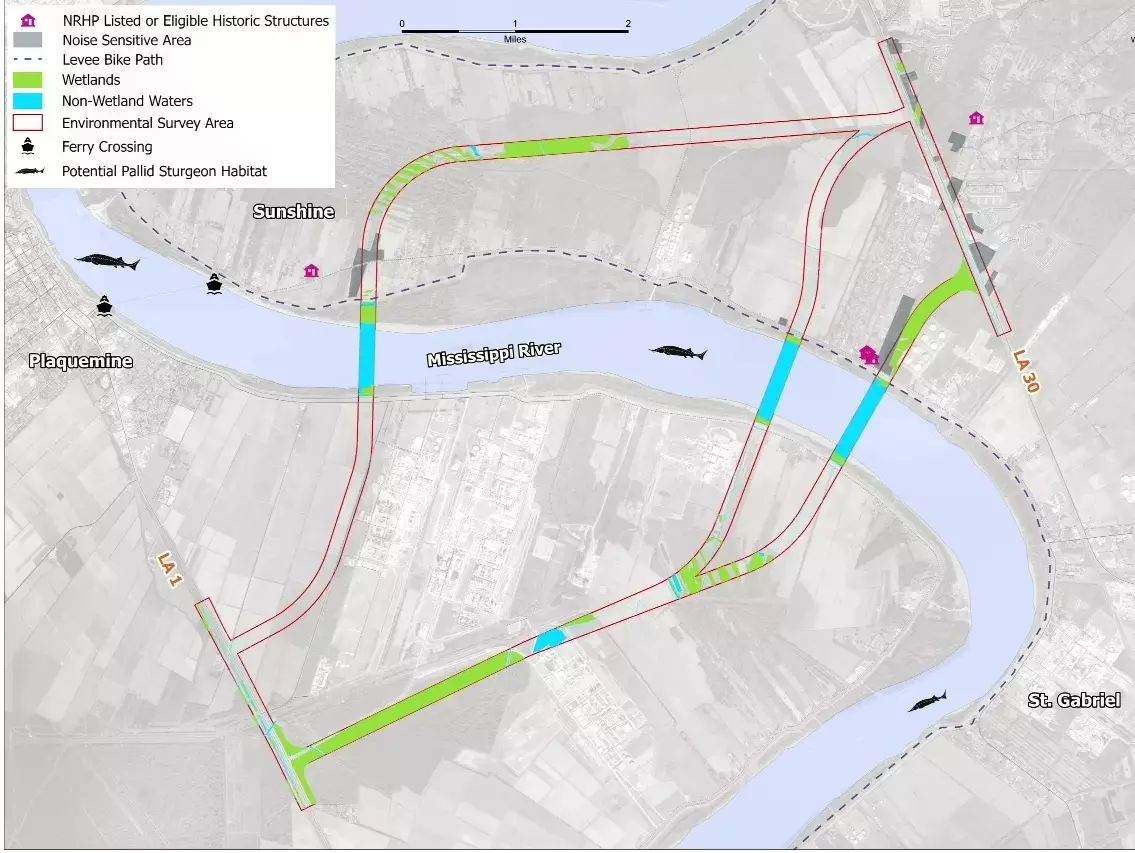
BATON ROUGE — The Capital Area Road and Bridge District got its first public look at construction cost estimates Monday for a proposed new Mississippi River crossing south of Baton Rouge, with price tags ranging from $1.78 billion to $2.04 billion — and state officials beginning the harder conversation about how to pay for it.
The district met at the Louisiana State Capitol Monday afternoon. East Baton Rouge Parish was not represented.
Three Alignments, Three Price Tags
DOTD project manager Christina Brignac presented cost estimates for the three remaining bridge alignments under environmental review. All figures are in 2026 dollars and include bridge construction, roadway, elevated sections, right-of-way acquisition, and wetland mitigation. They do not include final engineering design, additional environmental mitigation, or utility relocation.
- E11-4: $1.78 billion
- F13: $2.03 billion
- F14: $2.04 billion
E11-4's lower estimate reflects its bridge design, which requires two river piers rather than the three required by F13 and F14. All three alignments are proposed as two lanes in each direction on approach roadways and three lanes in each direction on the main bridge span.
Public Meetings Held; Comment Process Questioned
DOTD held two public meetings in March — one in Plaquemine on March 10 with approximately 73 attendees, and one in St. Gabriel on March 12 with approximately 106 attendees. Combined with two prior meetings in December, the project has now had four rounds of public input, generating roughly 174 comments from the March sessions alone.
One Plaquemine Point landowner raised a concern about an email sent to March meeting attendees stating that comments received after March 23 would be "appended" to the final environmental assessment rather than used to shape the selection of the preferred alternative. She said the email effectively discouraged further input from residents most directly affected by the project. Board officials said Brignac would follow up with the resident to clarify the intent of the email.
Next steps in the environmental process include identifying a preferred alternative, releasing a draft EA for public review, and holding public hearings. A draft EA is currently projected for December 2026.
How to Pay for It
The board heard a presentation from Tom Rusakis of Ernst & Young's Infrastructure Advisory Practice, who serves as DOTD's financial advisor on the Calcasieu River Bridge project. Secretary Glenn Ledet represented DOTD at the meeting. He walked the board through the spectrum of delivery options, from traditional publicly funded design-bid-build to full public-private partnerships, or P3s.
In a P3 arrangement, a private consortium designs, builds, finances, operates, and maintains the asset under a long-term concession — typically 30 to 50 years — with private capital at risk for performance. At the end of the concession, the asset reverts to the public. The key distinction from traditional delivery: private money, not public money, is on the line if the project underperforms.
The most complete form of P3 also shifts toll revenue risk to the private partner. The Calcasieu River Bridge, currently in procurement, is Louisiana's example of that model.
Board members began sizing the financing gap. One figure offered during discussion: $40 million in annual toll revenue, bonded over 50 years, generates roughly $700 to $750 million — well short of a $2 billion project. Board member Daigle separately noted that a half-cent sales tax across the five-parish district could generate approximately $100 million per year, and asked DOTD and its financial advisor to return with full lifecycle cost comparisons across all delivery models — not just upfront construction costs, but total long-term cost to the state.
Board Authorizes Consulting Firm Discussions
The board voted unanimously to authorize Chairman Campbell to work with DOTD before the next quarterly meeting in late June to explore retaining a consulting firm with public financing experience. The goal is to determine whether a formal RFP is needed and what options are available to the district.
Proposed Legislation Would Expand Board
Board member Chris Daigle, the Iberville Parish President, flagged House Bill 462, filed by Rep. Dixon McMakin, R-Baton Rouge, which would add up to five House members appointed by the Speaker and up to five senators appointed by the Senate President to the CARBD board — a potential maximum of ten legislators. Daigle noted the district already overlaps with existing legislative transportation committees and questioned the purpose of adding legislators directly to the financing body. McMakin was invited to Monday's meeting but did not attend.
Residents Push Back on E11-4
Every resident who addressed the board Monday opposed alignment E11-4, which would cross through the Plaquemine Point area on the west bank south of Baton Rouge.
The objections covered several fronts. On the environment, Dr. John Day — an emeritus professor in LSU's Department of Oceanography and Coastal Sciences with 50 years of field experience — testified that the forested wetlands at Plaquemine Point include trees estimated at 300 years old and represent one of the most ecologically significant swamp systems remaining in Louisiana. He said meaningful mitigation for a site of that age does not exist in the state.
On the data, landowner Laura Como presented a detailed challenge to the accuracy of DOTD's wetlands report, noting that DOTD had already acknowledged two incorrectly classified sample points at Plaquemine Point and asking that the report be reissued with corrected findings before a preferred alternative is selected. She also questioned why DOTD's own response letter stated the wetlands report was "not intended to compare alternatives" when wetland acreage was used as a comparison factor in narrowing the field from ten alignments to three.
On traffic, residents questioned the logic of routing a new crossing onto Highway 30, citing existing congestion on the corridor from LSU south toward Gonzales.
Chairman Campbell acknowledged the public comments and reminded those present that the district is a taxing authority — it does not select the bridge alignment. That decision is made jointly by DOTD and the Federal Highway Administration following the National Environmental Policy Act process.
What's Next
The district's next quarterly meeting is expected in late June. DOTD is expected to return with toll revenue projections, a value-for-money analysis, and lifecycle cost comparisons across delivery models.
Map courtesy Louisiana Department of Transportation and Development.
This story will be updated as additional information becomes available. Contact WBR Independent at wbrindependent@gmail.com.