Port Allen Native Angélique Roché Returns Home to Share Graphic Novel on 'Grandmother of Juneteenth'
By John Summers | WBR Independent | March 6, 2026
PORT ALLEN — Angélique Roché's first job at the West Baton Rouge Museum wasn't as an author. It was as a 15-year-old camp counselor, back when the building was still known as the Sugar Museum.
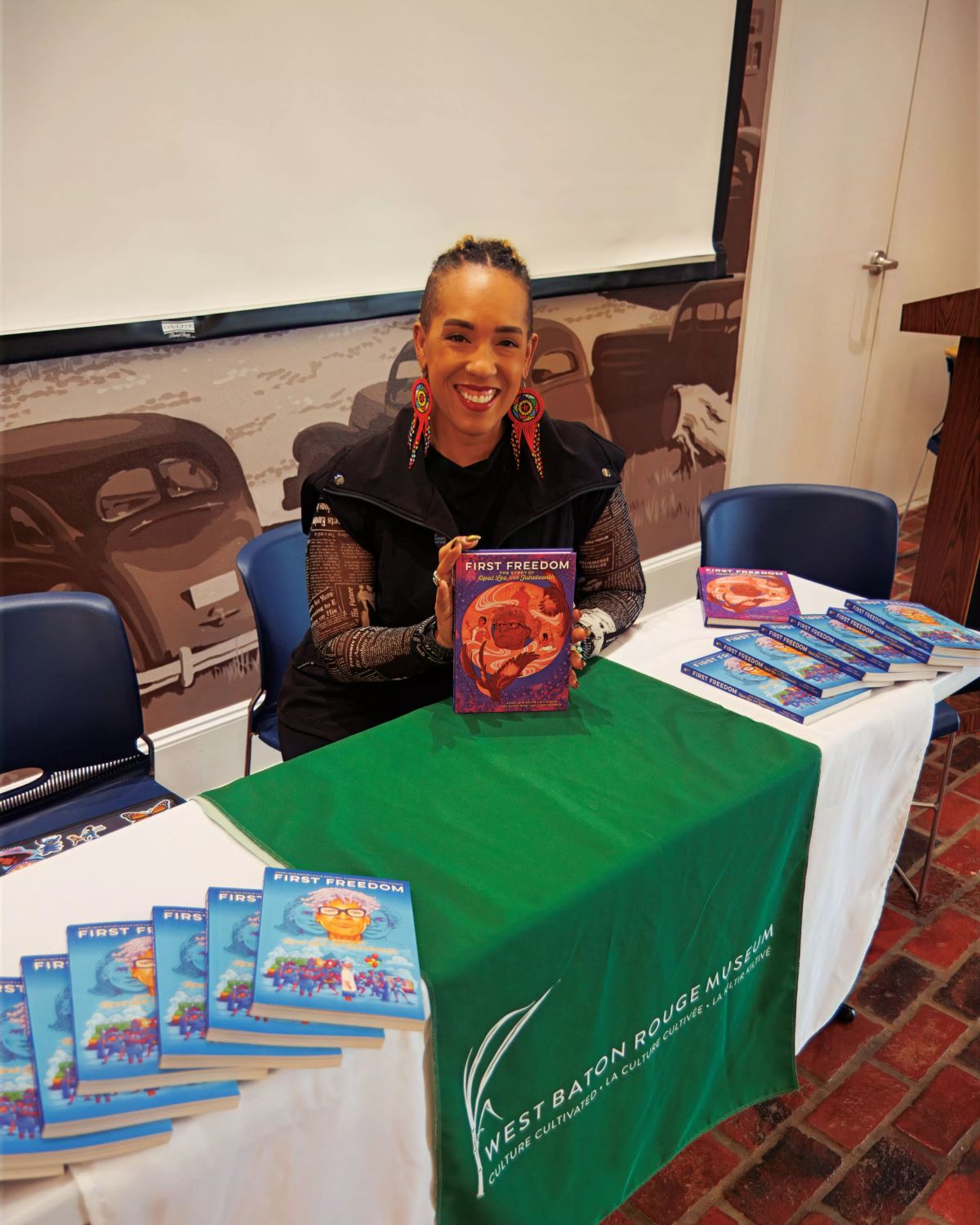
On Sunday, March 1, Roché returned to the museum at 845 N. Jefferson Avenue for a lecture and book signing — this time as the writer behind "First Freedom: The Story of Opal Lee and Juneteenth," a 200-page graphic novel biography of the 99-year-old activist known as the Grandmother of Juneteenth.
"Being able to come back here and possibly show little girls who look like me that this is something that they could do is pretty incredible," Roché said.
Roché, a journalist, producer, and attorney originally from Port Allen, said she moved back to the area to be closer to her parents, who still live in the parish. Her career has spanned outlets including NBC News, MSNBC, Marvel Studios, ESPN, and Paramount+, and she previously co-authored "My Super Hero Is Black" with Marvel Entertainment and Simon & Schuster.
A book built on primary sources
"First Freedom" traces the life of Opal Lee from her childhood in segregated Fort Worth, Texas, through her decades of activism that culminated in Juneteenth's recognition as a federal holiday in 2021. The book includes more than 140 citations, a historical timeline dating back to the 1800s, and a further reading list.
Roché said the project started with its subject. The book was Lee's idea.
"She believes that you can educate people, you can reach people, you can talk to people," Roché said. "And if people really understand the injustices that other people deal with, you can make a change."
Lee, who spent much of her career as a third-grade teacher, wanted a book accessible to young readers — which, by her definition, means anyone under the age of 99.
Roché said her training as a journalist and attorney drove the research process. When Lee mentioned that 500 people had gathered outside her family's home during a racial attack, Roché's first instinct was to find the article.
"I rebuilt her family tree by date. I went and looked up the actual government documents to confirm when people lived so we could get the right timeline," Roché said. "How old kids would be, what their clothing would be. Was somebody in the military? Because you can find that out from their draft card."
Newspapers turned out to be one of her most critical sources, particularly for the first 60 years of Lee's life.
"Back then, you had to publicly announce divorces. You had to publicly announce any kind of legal court case, period," Roché said. "And we didn't have the internet. So where was it going? The newspaper. That's where marriages, divorces, announcements, police activity, people buying land — all of that would have been recorded."
Three artists, three eras
The graphic novel uses three artists — Alvin Epps, Bex Glendining, and Millicent Monroe — to illustrate different periods of Lee's life. Roché said the decision, made alongside editor Megan Brown and editor-in-chief Sierra Hahn, was intended to give each era its own visual identity without jarring the reader.
"It would make each time frame feel different where it didn't jolt the reader out of it," Roché said. "It would still be seamless, but it wouldn't be one artist trying to figure out how do we switch between 1865, 1942, and 2008."
Roché said she paid close attention to visual details in her panel descriptions to the artists — noting when Fort Worth schools had and hadn't yet integrated, how characters traveled, and what they wore. She pointed to one example: when Lee arrives in New York in the book, she doesn't hail a cab. Someone meets her at the train.
"It's those little things, those little nuances that we wanted to make sure still existed in the piece," Roché said.
Names carry weight
Several characters in the book are named after Lee's real ancestors, including Sergeant Edmund Banks, named for her great-grandfather, and a young woman named after her great-grandmother, Mary Wynn.
Roché said she originally envisioned a three-part series beginning with Mary Wynn's story, which connects to the Moore plantation in Virginia and to broader, less commonly told history about enslaved people who traveled south rather than north to seek freedom through the Southern Underground Railroad.
"People's names have power," Roché said.
'She is a superhero'
Asked how telling a real person's story compared to her previous work in the Marvel superhero space, Roché didn't hesitate.
"She is a superhero," Roché said of Lee.
As for what she hopes a young reader in Port Allen takes away from the book, Roché said she wants them to know their stories matter.
"That they can relate to someone who grew up on a farm with no running water, who grew up and found joy even amidst oppression all around her, who grew up and still smiles about memories," Roché said. "And at 99 years old is still thinking about — there's still more to do. And that they're the hero that they've been looking for."
"First Freedom: The Story of Opal Lee and Juneteenth" is available wherever books are sold. It is published by Oni Press.